Florence Perfume History: Santa Maria Novella & the Medici
How Florence became a birthplace of European perfume — from the Dominican friars of Santa Maria Novella in 1221 to Catherine de' Medici and René le Florentin.
When you blend a fragrance in a Florence apothecary today, you are stepping into a craft that has been practised in this city for eight centuries. Few places have a deeper claim to European perfume than Florence — and the story runs through a single convent, a teenage queen, and the perfumer who carried Florentine scent to the French court. Understanding it makes a perfume masterclass feel less like a tourist activity and more like joining a very long line. Here is how it happened.
1221: the friars of Santa Maria Novella
The story begins with the Dominican friars who settled in Florence around 1221 and founded the convent of Santa Maria Novella. Tending a monastic herb garden, they began distilling balms, elixirs and scented waters from the plants they grew — medicine and fragrance were not yet separate crafts. By 1381 the friars were already selling pharmaceutical products made from their own medicinal plants.
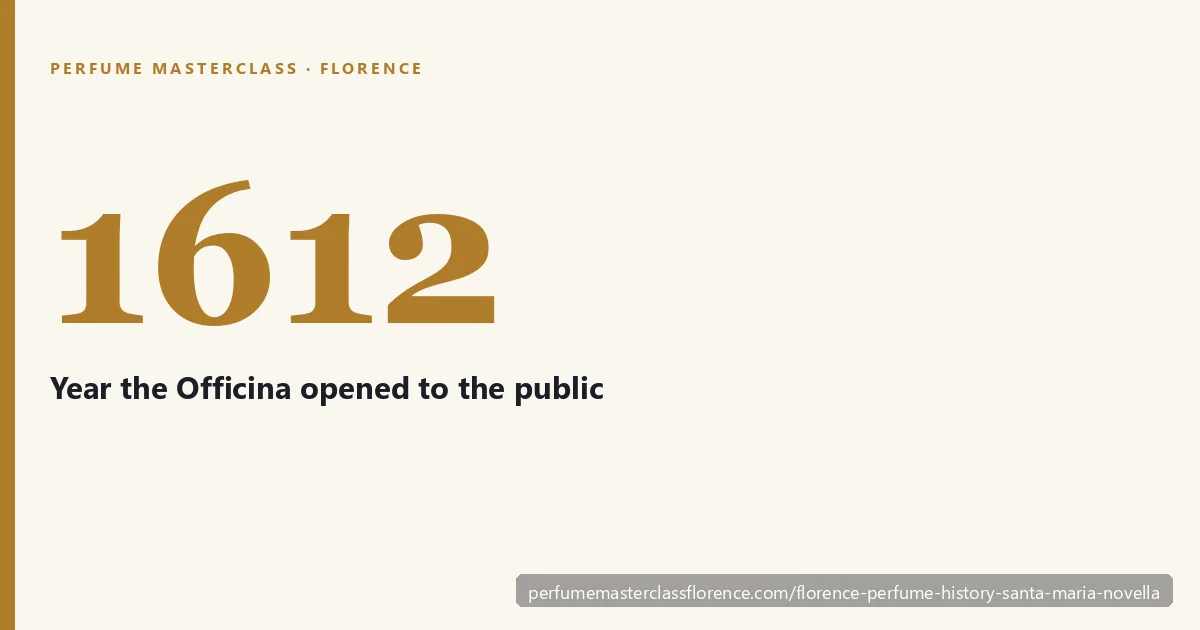
Their reputation grew until, in 1612, the apothecary opened formally to the public under the endorsement of the Grand Duke of Tuscany, taking the name it still carries: the Officina Profumo-Farmaceutica di Santa Maria Novella. It is widely described today as the oldest pharmacy in the world still operating where it began — and it is the historical heart of every perfume experience in the city.
1533: Catherine de’ Medici and René le Florentin
The most consequential chapter is also the most romantic. In 1533, when Catherine de’ Medici left Florence to marry the future Henry II of France, she did not travel alone. She brought her personal perfumer — Renato Bianco, an orphan raised by the Santa Maria Novella friars and taught herbal distillation in their workshops. In France he became known as René le Florentin.
For Catherine, the friars created a citrus fragrance meant to capture her beloved Florence: Acqua della Regina, “the Queen’s Water”. It mattered for more than sentiment. The scent is often credited as one of the first to be built on an alcohol base rather than the older vinegar or oil — which is why it is sometimes called the first recognisably modern perfume. It conquered the French court and helped seed the perfume culture that France is famous for today; it even lent its idea to what we now call Acqua di Colonia, or cologne.
| Year | Milestone |
|---|---|
| ≈1221 | Dominican friars found the convent of Santa Maria Novella |
| 1381 | Friars selling pharmaceutical products from their herb garden |
| 1533 | Catherine de’ Medici leaves for France with perfumer Renato Bianco |
| 1612 | The apothecary opens to the public as the Officina Profumo-Farmaceutica |
The living tradition: Florence’s modern perfume houses
Florence never let the craft fade into a museum piece. The city is still home to working perfumers who keep the tradition alive:
- Lorenzo Villoresi — a philosopher-turned-perfumer who founded his house in 1990 inside the family’s fifteenth-century palazzo on Via de’ Bardi, overlooking the Arno near the Ponte Vecchio. In 2019 he opened the Museo Villoresi, an interactive journey into how a fragrance is made.
- Aquaflor — an artisan perfumery in Borgo Santa Croce, known for bespoke fragrances composed in a frescoed Renaissance setting.
- Santa Maria Novella itself — still selling scents and elixirs whose recipes trace back through the centuries.
This is why a hands-on class in Florence feels different from a perfume workshop anywhere else: the essences, the apothecary setting and the very idea of “making your own scent” all descend from this unbroken local lineage.
Seeing the history for yourself
You can experience this heritage two ways. A guided visit to the historic Santa Maria Novella pharmacy lets you walk the original rooms and smell finished products — a museum-and-shopping experience rather than a hands-on one. A perfume masterclass lets you taste the tradition from the inside, blending your own composition the way the friars once blended theirs. Many visitors do both: the tour for context, the class to create. For help deciding, see our guide to the best perfume workshops in Florence.
Ready to Book?
The best way to understand eight centuries of Florentine perfume is to make some of your own. The featured masterclass puts a master perfumer, a kit of natural essences and a 30 ml bottle of your own scent in your hands — check availability and book on the homepage.
Bottle Your Own Florence Scent — Book the Masterclass
Join 576+ guests who rated this experience 4.7/5. A master perfumer, a kit of natural essences, and a 30 ml signature scent to take home — all included. Free cancellation up to 24 hours before.
Check Availability & Book